Broken Ankle in Houston: From ER Visit to Walking Again — A Surgeon’s Guide
Dr. Schauder explains the typical steps after an ankle fracture — emergency care, when to involve an orthopedic surgeon, stabilization options, what recovery often looks like, and realistic milestones for walking and driving again.

Why this guide matters
I’m Dr. Schauder of Bay Area Sports and Orthopedics in Houston. As an orthopedic surgeon who’s treated athletes and community members for decades, I’ve seen how frightening an ankle fracture can be. This guide walks you through what usually happens from the emergency room onward so you know what to expect, what questions to ask, and how we plan care to get you safely back on your feet.
First hours: what happens in the emergency room
When you arrive at the ER the focus is rapid assessment: controlling pain, checking blood flow and nerve function, and getting images to define the break. Emergency clinicians will often immobilize the ankle in a splint, apply ice and elevation, and arrange x-rays or CT scans if needed. Open fractures, significant deformity, or signs of compromised circulation require urgent attention. The emergency team stabilizes you and arranges follow-up with orthopedics when appropriate.
When an orthopedic surgeon should be involved
Some ankle fractures are stable and can be managed non-surgically, while others need early orthopedic care. You should see an orthopedic surgeon for fractures with displaced bone fragments, an unstable ankle (several bones involved), joint incongruity, syndesmotic (high ankle) injuries, open wounds, or any loss of pulses or sensation. If you cannot bear weight safely, or if the ankle looks deformed after initial splinting, ask the ER team for an orthopedic consultation.
Stabilization and the types of treatment we use
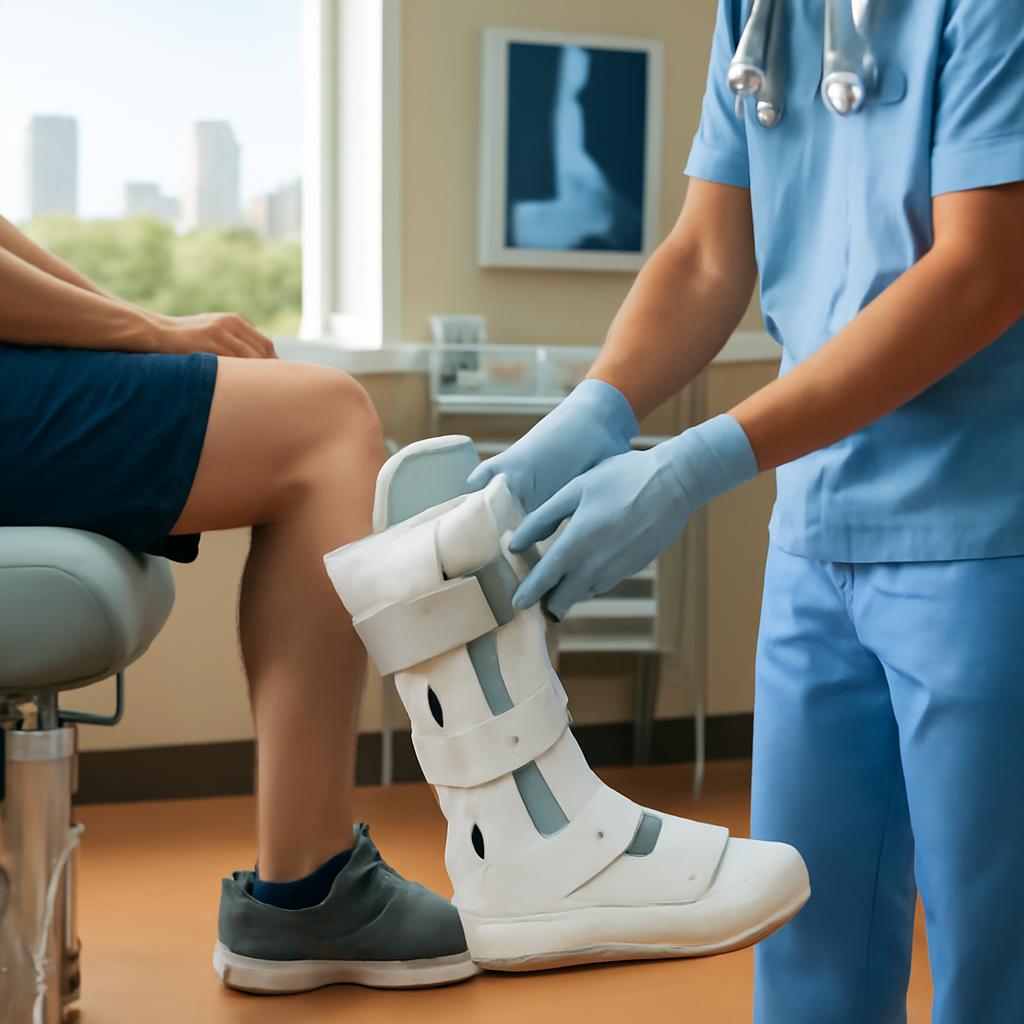
Treatment ranges from conservative immobilization to surgical fixation. For stable, well-aligned fractures we often use a removable boot or cast and close follow-up to confirm healing. If the fracture is displaced or unstable, surgical stabilization — using plates, screws, or other implants to restore bone alignment and joint surface — is commonly recommended. In severe or open injuries, temporary external fixation may be used before definitive surgery. The choice depends on the fracture pattern, soft-tissue condition, and your overall health.
What recovery typically looks like
Healing time varies with the injury and the person. Factors such as fracture severity, bone quality, other medical conditions, and adherence to rehabilitation all affect recovery. Many patients progress through a period of immobilization, then a controlled return to motion and weight-bearing under guidance. One patient I treated reported returning to good function within about three months, which is encouraging but not guaranteed for everyone — individual timelines differ.
Rehabilitation: regaining motion, strength, and balance
Rehab is a crucial part of returning to walking and activity. Early work focuses on restoring ankle range of motion and controlling swelling. As the bone heals, we introduce strengthening, balance training, and gait re-education. Weight-bearing is advanced in stages based on x-ray healing and clinical exam; your surgeon and therapist coordinate the plan. Consistent rehab speeds recovery and helps reduce stiffness and long-term problems such as weakness or instability.
Driving, returning to work and sports, and next steps
When you can drive depends on which leg is injured, how immobilized it is, and whether you can react quickly and safely — your surgeon must clear you before driving. Returning to work or sport depends on the physical demands of your activities and your healing progress. If you’ve had a serious fracture, plan for a stepwise return with protective measures as advised. If you or a loved one fractures an ankle in the Houston area, seek ER care for immediate stabilization and arrange an orthopedic evaluation at Bay Area Sports and Orthopedics (12827 Gulf Freeway) so we can outline a safe, individualized recovery plan.
Customer review


Article by
Dr. Schauder - Houston
Dr. Schauder was born in Detroit, Michigan. He received his undergraduate degree from Albion College, Albion, Michigan in 1981 Summa Cum Laude with a 4.0 GPA, Phi Beta Kappa, Albion Fellow. Dr. Schauder is an orthopedic surgeon with over 20 years of experience in orthopedic surgery and sports medicine . Dr. Schauder is very active in the sports community. He has played football through college and has played and coached his sons in soccer. Dr. Schauder has been the team physician for Alvin High School Sports since 1990. Our concern is for the total well-being of the patient and to return the patient back to their active lifestyles including sports and work as soon as possible.